Getting around · Mexico City
Do You Need a Car in Mexico City? (2026)
No — not until you leave the valley.
No — you do not need a car in Mexico City. The Metro alone runs 12 lines and 195 stations at a flat 5-peso fare, the same price whether you ride two stops or forty, and it moves more than 4.5 million people a day. Driving yourself is the option the city actively works against: the Hoy No Circula programme grounds most cars one weekday a week, and a foreign-plated car cannot legally drive on any Saturday without a free permit. A vehicle only starts to earn its keep the moment you leave the valley — the pyramids, Puebla, the Tolantongo canyon — and for those days the sensible move is to hire the vehicle with a driver in it at a flat rate for the whole car, not per seat.
- Metro fare
- 5 pesos flat, any distance
- The network
- 195 stations 12 lines, 4.5 M riders a day
- Metrobús fare
- 6 pesos card only, no cash
- Whole car, day trip
- $320 SUV round trip to Teotihuacan
Getting around Mexico City, at a glance
Do you need a car?
Not inside the city. Between the Metro (5 pesos flat), the Metrobús (6 pesos) and app taxis, every trip a visitor makes is covered. A car becomes useful only for day trips outside the metropolitan area.
Who is each option for?
Solo and budget travellers: the Metro. Nights, luggage and door-to-door hops: an app taxi. Families with a toddler, groups, and any trip outside the city: a private driver, because the price is per vehicle.
How much does it cost?
A Metro trip is 5 pesos, a Metrobús trip 12, and the Movilidad Integrada card 15 pesos plus your first top-up. Our own fares are per vehicle: $100 from the AICM airport, $320 round trip to Teotihuacan, $360 for an eight-hour day charter.
How does the driver option work?
You pick a route, see the flat per-vehicle price, and pay by card or PayPal. The driver collects you at your hotel and waits while you explore. Compare every route on our per-vehicle prices.
Every way to get around Mexico City, compared
Six ways to move, and none of them wins everywhere. The honest version of this table is the one that tells you when not to hire a driver — most of a city-only trip is one of the first three rows.
| Option | What it costs | Best for | Where it fails |
|---|---|---|---|
| Metro | 5 pesos flat per trip, any distance | Crossing the city at rush hour, when it beats every road option | Closed overnight; mostly stairs, so a stroller or a big suitcase is hard work |
| Metrobús & Trolebús | 6 pesos with the Movilidad Integrada card; 30 pesos on Line 4 to the airport terminals | Long straight corridors such as Insurgentes and Reforma | Card only, no cash; little luggage space; crowded at peak |
| Walking & bike share | Free, or a low membership on the city bike scheme | Inside Roma, Condesa, Juárez, Centro Histórico and Coyoacán | Useless across the city; altitude and rain season make long walks tiring |
| Uber / Didi app taxi | Metered in the app; the fare moves with demand | Nights, rain, luggage, and door-to-door trips inside one district | Price is unknown until you book; supply thins out at the city edge and at day-trip sites |
| Driving a car you rent yourself | Daily hire plus fuel, tolls, parking and insurance | Long, multi-day trips well outside the valley | Grounded one weekday a week by Hoy No Circula; a foreign plate is banned every Saturday without a permit |
| Group day tour | Per person — the total multiplies with every traveller | A solo traveller who wants a guide and company | Fixed departure, shared with strangers, rarely carries child seats |
| Private driver | Flat per vehicle: $100 from the AICM airport, $320 round trip to Teotihuacan, $360 for eight hours | Families, groups, luggage, child seats, and any trip outside the city | Overkill for a single passenger crossing town — take the Metro |
Peso fares are the published public-transport tariffs for 2026. Our own fares are in US dollars, per vehicle, and already include fuel, tolls, parking and waiting time.

Do you need a car in Mexico City?
No. Mexico City is one of the few megacities where a visitor is measurably better off without one. The reason is not just that public transport is cheap — it is that the city is legally hostile to the private car. Hoy No Circula takes most vehicles off the road one day a week. Central parking is scarce and metered. And the trips a tourist actually makes — Centro to Roma, Roma to Coyoacán, Coyoacán to a dinner reservation — are exactly the trips where a car is slowest.
The question that matters is narrower than "car or no car". It is: on which days does a vehicle change the day? There are three, and only three. Arriving with luggage. Leaving the metropolitan area for a day trip. And travelling with someone who cannot do stairs — a toddler in a stroller, a grandparent, a knee. On every other day, the Metro is not a compromise; it is the fastest thing available.
Getting around Mexico City as a tourist
The working pattern is three layers deep. Walk inside a neighbourhood — Roma and Condesa are laid out for it. Take the Metro or Metrobús between neighbourhoods — a flat 5 pesos on the Metro, 6 on the Metrobús, both paid with the Tarjeta de Movilidad Integrada, a contactless card that costs 15 pesos plus your first top-up and is sold at any Metro ticket window. Use an app taxi after midnight, in heavy rain, or whenever you are carrying more than a day bag.
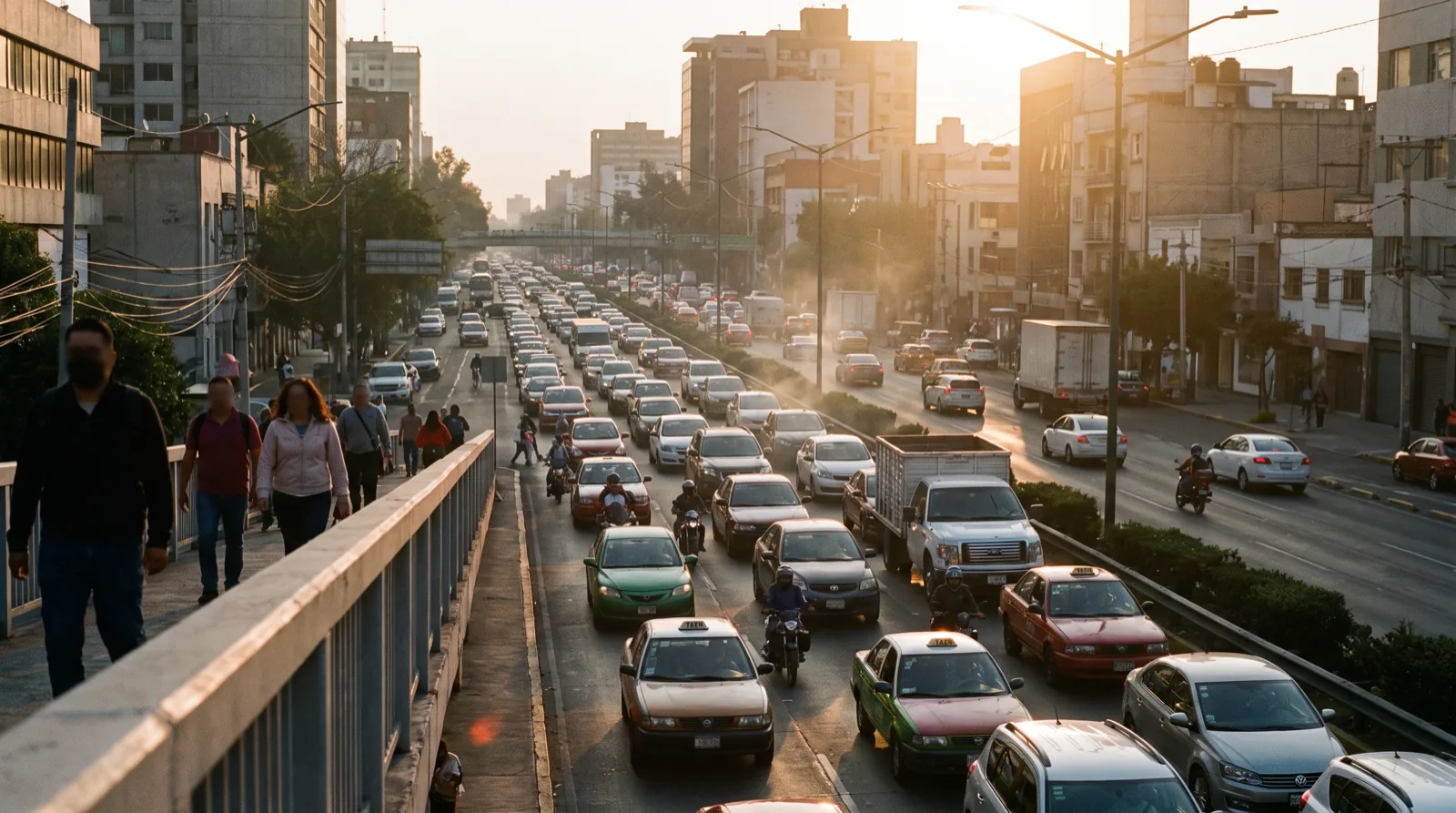
What no guide tells you plainly: the Metro's advantage is largest exactly when the roads are worst. At 18:00 on a Friday the difference between the Metro and any vehicle is not a few pesos, it is forty minutes. If your plan for the day is inside the city, a driver waiting outside is money spent to sit in the same traffic you could have skipped underground.
Is renting a car in Mexico City worth it?
Rarely, and almost never for a city-only trip. A private driver is not a car rental: you can rent a car in Mexico City at the airport counters, and nothing stops you — but the city's own rules make a self-driven car the least reliable vehicle on this page.
Hoy No Circula is the reason. The programme bans vehicles from the road between 05:00 and 22:00 across the 16 boroughs of Mexico City and 18 municipalities of the State of Mexico, on a fixed weekday assigned by the last digit of the licence plate. Cars carrying a 00 or 0 emissions hologram — typically the newest ones, which is what most hire fleets run — are exempt from the weekday ban, so a locally-plated recent car often escapes it. A car you drove in yourself does not.
| Day | Sticker colour | Plates that cannot drive |
|---|---|---|
| Monday | Yellow | Ending in 5 or 6 |
| Tuesday | Pink | Ending in 7 or 8 |
| Wednesday | Red | Ending in 3 or 4 |
| Thursday | Green | Ending in 1 or 2 |
| Friday | Blue | Ending in 9 or 0 |
Hours are 05:00–22:00. Holograms 00 and 0, electric and hybrid vehicles are exempt from the weekday ban.
Then come the costs nobody quotes you. You pay for the car on the hours it is parked outside a museum, not the hours it moves. You pay for metered kerb space in the central boroughs. And you carry the two risks a driver absorbs for you: a parking-lot scrape in a city of narrow colonial streets, and an unfamiliar road system where a missed left turn means a twenty-minute loop. Driving yourself makes sense for a long trip well outside the valley. For everything else, hiring the vehicle with someone who already knows the roads costs less in total and far less in attention. Compare the two directly on our per-vehicle prices.
Getting around Mexico City with kids — and with a toddler
This is where the honest answer changes. A solo traveller loses nothing by skipping a car; a family with a toddler loses the whole afternoon. The Metro reserves its front carriages for women and children, which genuinely helps, but most stations are stairs-only — a folded stroller, a nappy bag and a three-year-old down two flights at 18:00 is not a plan, it is an ordeal. Metrobús has no room for a stroller at peak. And an app taxi dispatches whichever car is nearest, so you cannot count on a child restraint being in it, even though Mexico City's traffic rules keep young children in the back seat and in an approved seat.
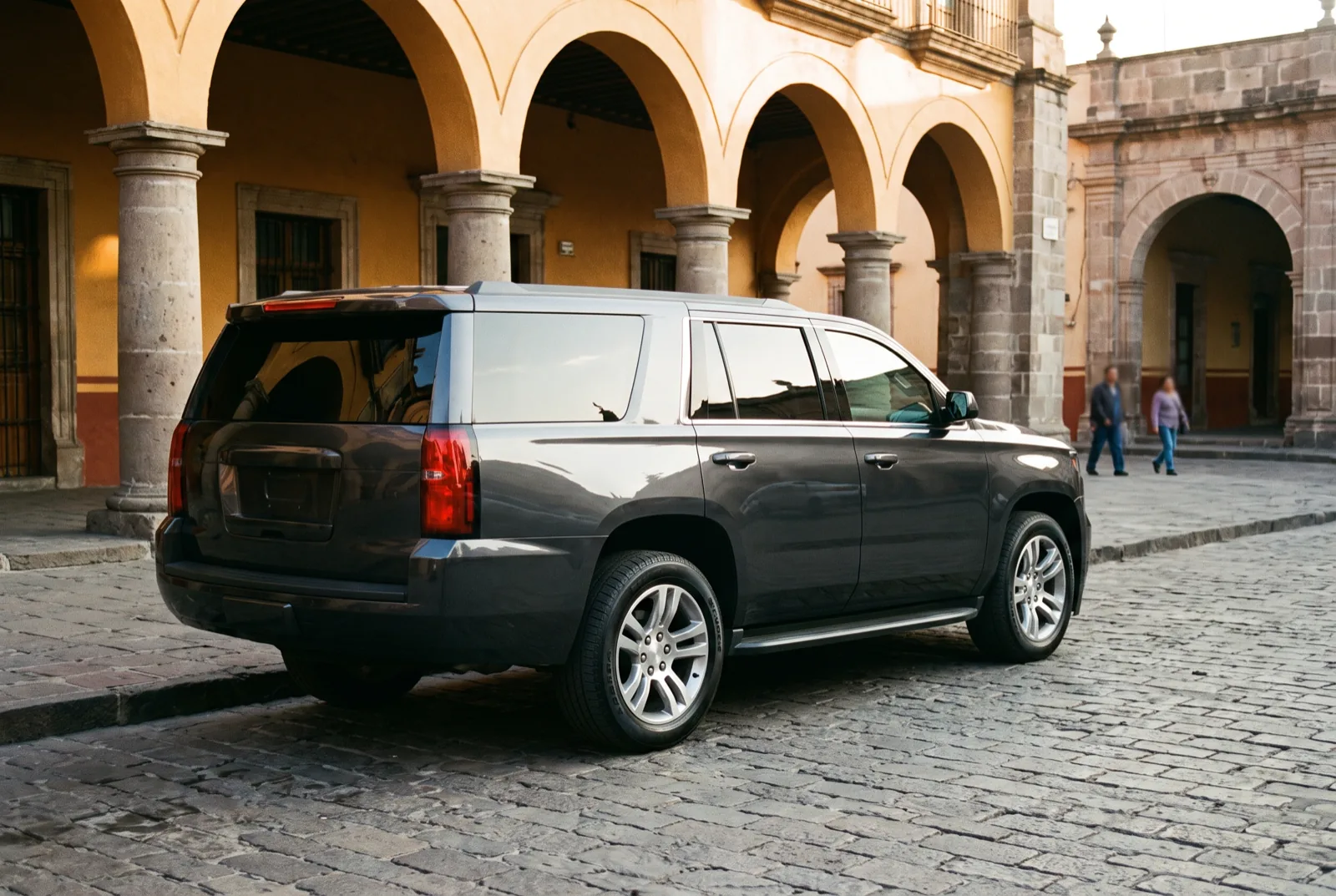
The structural fix is the pricing model rather than the vehicle. A group tour and a per-seat marketplace both charge by the head, so a toddler who occupies a seat costs the same as an adult who drinks the mezcal. Our fare is per vehicle, which means the head count is simply not part of the sum.
- SUV — Ford Explorer
- 6 passengers · 4–5 bags
- Van — Sunray / Transit
- 16 passengers max · 14–16 bags
- Family of five, SUV
- $64 each, round trip to Teotihuacan
- Ten in the van
- $38 each, same pyramids run
The driver waits, so the vehicle is a base: the nap happens in the car, the spare clothes stay in the car, and you are never negotiating a ride home with a tired toddler on your hip. The SUV, a Ford Explorer, seats six passengers with room for 4–5 bags; the van seats up to 16 passengers and takes 14–16 bags. See the units on our vans and SUVs.
Can you live in Mexico City without a car?
Yes, and a very large share of residents already do — the Metro alone carries more than 4.5 million passengers a day. The central colonias were built before mass car ownership and still work that way: in Roma, Condesa, Juárez, Centro Histórico, Coyoacán and San Rafael, the shop, the market, the clinic and the Metro entrance are all inside a walk.
The real trade-off is not mobility, it is time and edges. Without a car you plan around the Metro's overnight closure and around rush hour, and you accept that trips to the far edges of the metropolitan area — the northern municipalities, the outer State of Mexico — are slow by any means. Residents who go car-free typically keep a monthly budget for app taxis for those edges, which still lands well below the cost of owning, insuring, verifying and parking a car in a city that bans it from the road one day a week.
Visitors staying a month or more converge on the same pattern: no car, heavy Metro use, app taxis at night, and a hired driver for the day on the two or three occasions the day genuinely needs a vehicle.
When you actually do need a vehicle
Three occasions, and they are the only three.
- Airport, one way
- $100 SUV from AICM, flights monitored
- Teotihuacan, round trip
- $320 SUV, waiting time included
- Day charter
- $360 eight hours, your itinerary
The airport run
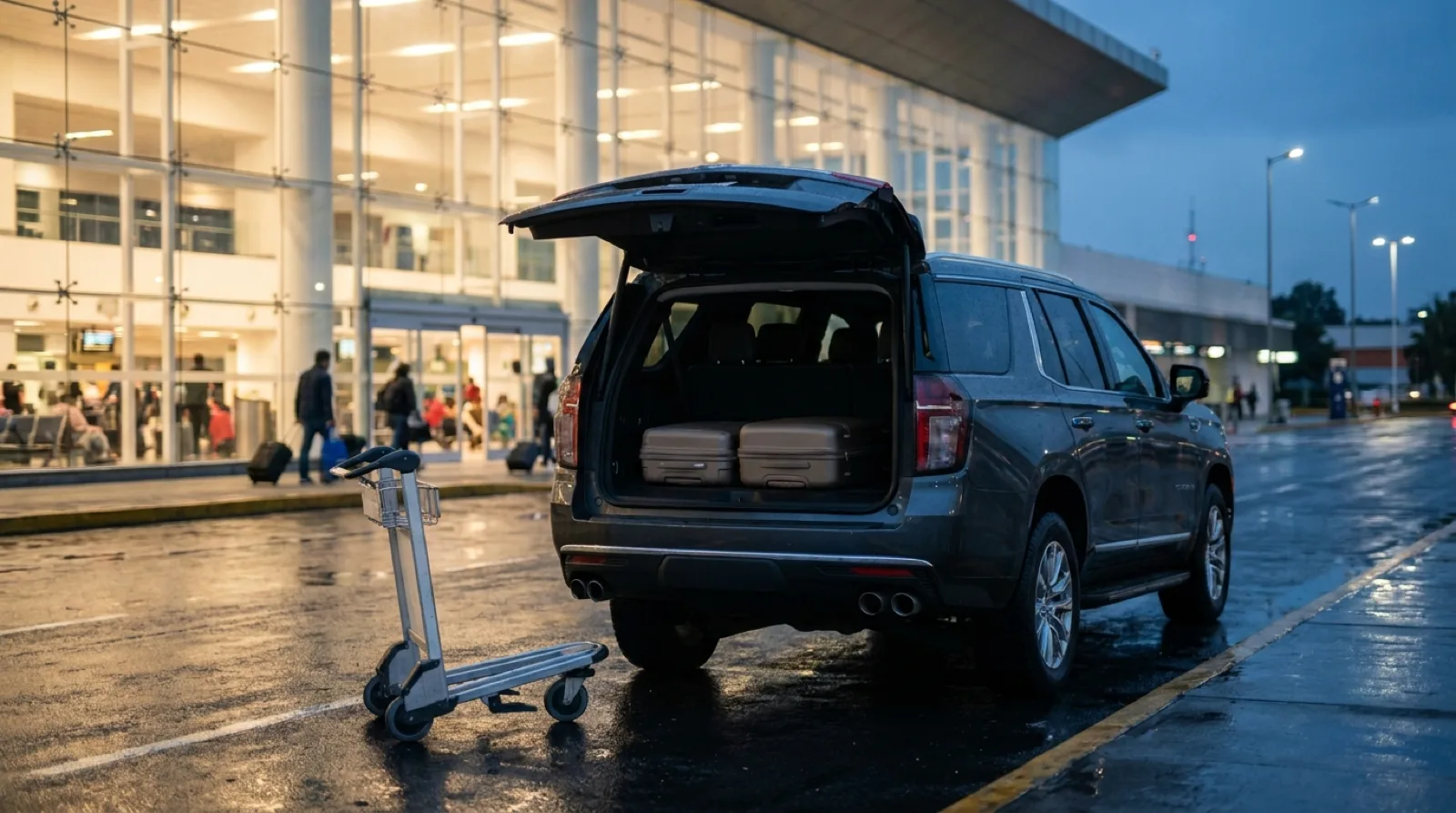
Arriving at 23:40 with two suitcases and a sleeping child is not a Metrobús moment; a Mexico City airport transfer meets you inside the terminal with a name sign at a flat $100 for the SUV from the AICM, monitored against your flight number so a delay costs nothing.
The day trip
Teotihuacan, Puebla, Tepoztlán, Taxco and Tolantongo all sit outside the reach of the Metro, and the return leg is where public options and app taxis both break down. A private driver to Teotihuacan is a flat $320 for the whole SUV including waiting time, and every other route is listed under private day trips from Mexico City. If you want the pyramids specifically, the bus-versus-app-taxi maths is worked out in how to get to Teotihuacan from Mexico City.

The packed day inside the city
Museum in the morning, Coyoacán in the afternoon, a reservation across town at night, with luggage or small children in the mix — that is when an eight-hour charter at $360 stops being a luxury and starts being cheaper than four separate app taxis plus the waiting.
What visitors actually ask us for inside the city is a short list, and not one item on it is a day trip. They are all points within Mexico City, which is why none of them carries a price of its own — they are one product: hire a driver for the day, eight hours at a flat $360 for the SUV, spent however you like. The common shape is a chain this page has effectively been arguing for all along: the Xochimilco trajineras in the morning, the Coyoacán market in the afternoon — neighbouring boroughs in the south, so that pair costs almost nothing in crossing — and lucha libre at Arena México in the evening, back in the centre. A taco crawl slots into the same eight hours.
Skip the car, keep the freedom
Use the Metro for the city. When the day needs a vehicle, book one flat price for the whole car — hotel pickup, English-speaking driver, child seats free on request, free cancellation up to 24 hours before.
See our per-vehicle pricesPlan the rest of your trip
- Our per-vehicle prices — every route and vehicle, all-inclusive, in one table.
- Mexico City airport transfer — meet-and-greet with a name sign, flight monitoring, flat fare.
- Private driver to Teotihuacan — the pyramids day trip, waiting time included.
- Private day trips from Mexico City — Puebla, Tepoztlán, Taxco, Tolantongo and more.
- Hire a driver for the day — eight hours, your itinerary, one flat price.
- Our vans and SUVs — the Ford Explorer and the JAC Sunray / Ford Transit vans, with child seats on request.
- Is it safe to hire a private driver — how drivers are vetted and why street taxis are the real risk.
The full picture: Mexico City without a car
Travellers ask this in a dozen shapes — do you need a car in Mexico City, is Mexico City walkable, getting around Mexico City as a tourist, getting around Mexico City with kids, getting around Mexico City with a toddler, can you live in Mexico City without a car, is renting a car in Mexico City worth it — and the answer barely moves between them. For the city itself, no. One variant we deliberately do not put a figure on, because we are no hire desk: how much is it to rent a car in Mexico City is a question for the counters at the airport, not for this page.
The Metro's 12 lines and 195 stations at a flat 5-peso fare, the Metrobús at 6 pesos on a contactless card, and app taxis for the gaps cover the entire trip a visitor makes, and they do it faster than a car at exactly the hours a car is most tempting. The forum consensus that sends people looking for a Reddit thread on this question is right, and it is right for a reason the threads rarely state precisely: Hoy No Circula makes a private car an unreliable asset.
Between 05:00 and 22:00, across the 16 boroughs of Mexico City and 18 municipalities of the State of Mexico, vehicles are banned by the last digit of the plate — 5 and 6 on Monday, 7 and 8 on Tuesday, 3 and 4 on Wednesday, 1 and 2 on Thursday, 9 and 0 on Friday. Holograms 00 and 0 escape the weekday ban. A foreign or out-of-state plate does not: without the free Pase Turístico from SEDEMA it cannot drive on any Saturday, cannot drive on weekday mornings, and still takes its plate-digit rest day.
Where the answer does change is the day you leave the valley, and the family travelling with a small child. Both come down to the same structural point: how the fare is calculated. Group tours, per-seat marketplaces and app taxis all price by the head or by demand, which is why a family of five is punished for being five. This service is priced per vehicle, not per person, and the number does not move when you add a passenger, a suitcase or a child seat.
The SUV — a Ford Explorer seating six passengers with 4–5 bags — is $320 round trip to Teotihuacan and $360 for an eight-hour day charter; the van, a JAC Sunray or Ford Transit seating up to 16 passengers with 14–16 bags, is $380 on the same pyramids run. Divide those and the comparison stops being close: $64 each for a family of five in the SUV, $38 each for ten people in the van.
Fuel, highway tolls, parking and the driver's waiting time are already inside the figure; there is no surge, no per-seat charge, no obligatory tip, and infant, toddler and booster seats are fitted free before pickup. Take the Metro for the city — it really is the better tool. Book the vehicle for the airport, the day trips and the days when someone in your party cannot do two flights of stairs with a stroller.